
MHS MHS Composition Admin
Resources ↓
Administrator
Admin Panel
Program Overview
Aggregate performance across the writing program, by grade level. No individual student data is shown here.
Loading program metrics…
Live Sample Views
Preview what students and teachers see in their dashboards. Each sample pulls a random live account so you can verify data integrity, check how assignments and scores are rendering, and walk through the interface as an end user would without touching anyone's real session.
    Philosophy & Workflow
    Philosophy, workflow, and stage-by-stage process guide

    The MHS English Department uses a structuralist approach to the teaching of writing (Writing-with-Colors) intended to help students identify and internalize the conventions of well-developed, text-based composition through a system of simple color coding. The overriding goal of our instruction is to help students understand the logical links behind their compositions to see how all the parts hang together into a larger, coherent whole. Writers can never realize their own style until they have a strong sense of structure about what and how they are writing. In a nutshell, it’s our goal to get all students to this place.

    Our approach — one where conversations about writing are conducted with common terms and approaches — has the added benefit of providing students with a sense of symmetry between the English courses they take. The assessment/feedback loop provides a unique exigency for students to designate their own goals as writers that can be achieved in the next assignment, the next semester, or even the next year. Such an approach allows teachers, in turn, to see with clarity the effects of their efforts in the classroom while also giving teachers a sense of coherence between the courses they teach and with colleagues in the department. In other words, our approach to composition instruction provides a unique professional opportunity to let teachers theorize on their practices and to make adjustments both for their own sake and for the sake of their students.
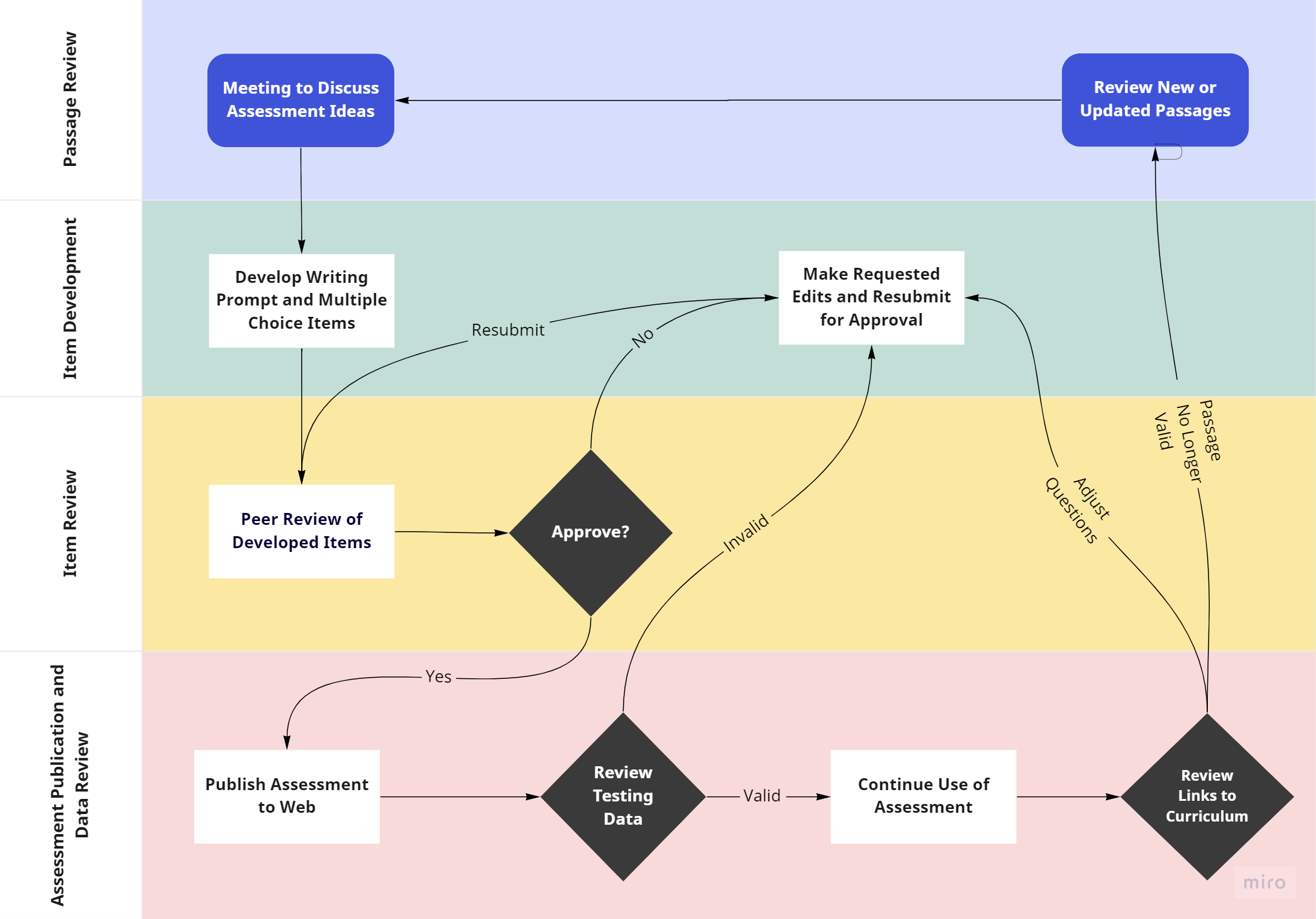
    Assessment workflow diagram showing the four stages from passage review through publication and data review
    Assessment development, review, administration, and data review workflow
    Stage-by-Stage Process
    1Initial Meeting & Passage Review

    All teachers convene for an initial meeting to discuss which text(s) will be used as the source of the question development process. During the meeting, teachers will:

    • Provide an overview of the composition process, color signification system, and reading/writing approaches that animate Writing-with-Colors
      • After the initial meeting, teachers can consult the Resource Library (Multi-Language Lessons, Transcripts, Materials).
    • Select potential excerpts from course texts to serve as basis for writing assignments. Discussion questions to ground the selection:

    Literary Analysis Passages

    • Primary passage: Does the excerpt hold together as a standalone piece? Is there a better passage from this text? Should it be cut/expanded (target: 750–1,250 words)? Does it rely too much on prior knowledge outside the excerpt?
    • Auxiliary passage: Is it developmentally appropriate in length, vocabulary, and topic? Does it have enough merit? Should it be cut/expanded? Does it have a strong voice that fits the chemistry of the primary text?
    • Text pair: Does it balance accessibility with Grade 10 expectations for the intended course level? Do any words or concepts need footnoting?
    • Prompt: Is there enough from each passage for a multi-paragraph response? Does the wording need clarification or revision?

    Argument Questions

    • Passages: Does the pair thematically match the taught course material? Do the excerpts hold together as standalone pieces? Should either be cut/expanded (target: 750–1,000 words)? Does either rely too much on prior knowledge?
    • Text pair: Does it balance accessibility with Grade 10 expectations for the intended course level? Do any words or concepts need footnoting?
    • Prompt: Is there enough for a multi-paragraph response along the colorized model? Does the wording need clarification?
    • Determine a provisional timeline for when tasks will be administered and in what order.
    2Passage & Question Drafting

    Based on the initial round of planning, the writing coordinator will:

    • Pair the selected class text with an auxiliary text(s) based on shared characteristics (theme, style, tone, etc.)
    • Write a governing prompt to give shape and direction to the writing task
    • Compose a series of corresponding multiple choice questions (if applicable)
    • Format the documents and submit for review and approval from classroom teachers
    3Review, Revisions & Approval

    After the draft item set is complete, teachers will:

    • Review the prepared draft and submit a review/approval on the Peer Review for Assessment Items page
    • Based on teacher feedback, the writing coordinator will make requested edits and submit for a second round of approval
    • Once approved, the writing coordinator will prepare the assignment to be administered online. All completed websites can be found in the Online Assessment Bank
    • Set an intended date for the assignment’s administration to students
    4Classroom Instruction & Administration

    Now in the classroom with live students, teachers will:

    • Instruct students on the basics of how to critically read and write using Writing-with-Colors as the basis. A complete video library of model lessons can be consulted at any time in the Resource Library.
    • Practice the reading and writing processes to help ensure students have a basic understanding of approach and execution
      • Students will likely confuse what should be what color at first — this is okay. Give them time to learn the pattern and let them wrestle with it; any discussion about the colors is good discussion.
      • Emphasize close reading of evidence and analysis under the direction of the prompt. If students cannot read the passage, they cannot use Writing-with-Colors.
      • Students need multiple opportunities to practice in low-stakes situations.
      • Regular practice is key — it’s not a bad idea to use the colors as the basis for reading/writing generally in the course.
    Administration of Writing Assessments

    Once instruction has taken place, teachers will:

    • Administer the online assessment developed in conjunction with the writing coordinator and have students submit their essays via the website
    • Track submissions in real-time by consulting their class dashboard on the Scores, Feedback, & Instructional Planning Reports page
    5Scoring, Commentary & Feedback

    After submission, the writing coordinator will:

    • Score and provide personalized narrative commentary for every essay written in the current assessment cycle
    • Generate commentaries and scores within approximately 24 hours to ensure feedback is timely and relevant
    • Update the teacher’s class dashboard on Scores, Feedback, & Instructional Planning Reports — teachers can review prior to returning to students
    Student Goal-Setting

    After assessment of student writing has occurred, teachers will:

    • Return scores and commentaries to students by sharing Google documents with them directly
    • Provide time for students to read their essay, scores, and comments in order to generate a set of writing goals
    • The writing coordinator will address the degree to which students have advanced toward their identified goals during the next commentary cycle
    • Writing goals that students record on their dashboards are directly accessible during the next round of scoring to promote genuine, authentic dialogue on student writing
    Performance Data & Instructional Planning Reports

    After the completion of the current assessment cycle, the writing coordinator will:

    • Prepare instructional planning reports for each class section detailing:
      • Trends in individual student performance from one assessment to the next
      • Trends in class-level performance from one assessment to the next
      • Trends in grade-level performance from one assessment to the next
    • Update the teacher’s class dashboard with instructional planning findings (see the Teacher View on this page for an example)
    • Conduct follow-up conversations with individual teachers regarding patterns and trends in student performance
    Digital Portfolios & Score Archiving

    After the completion of all assessment cycles for the current school year, the writing coordinator will:

    • Add all scored assessments from the year to each student’s Digital Portfolio of Student Work
    • Invite students to reflect on their performance across the year and from year-to-year (time permitting)
    • Move all class scores, commentaries, and instructional planning reports to the Score Report Archive for future retrieval
    Resources